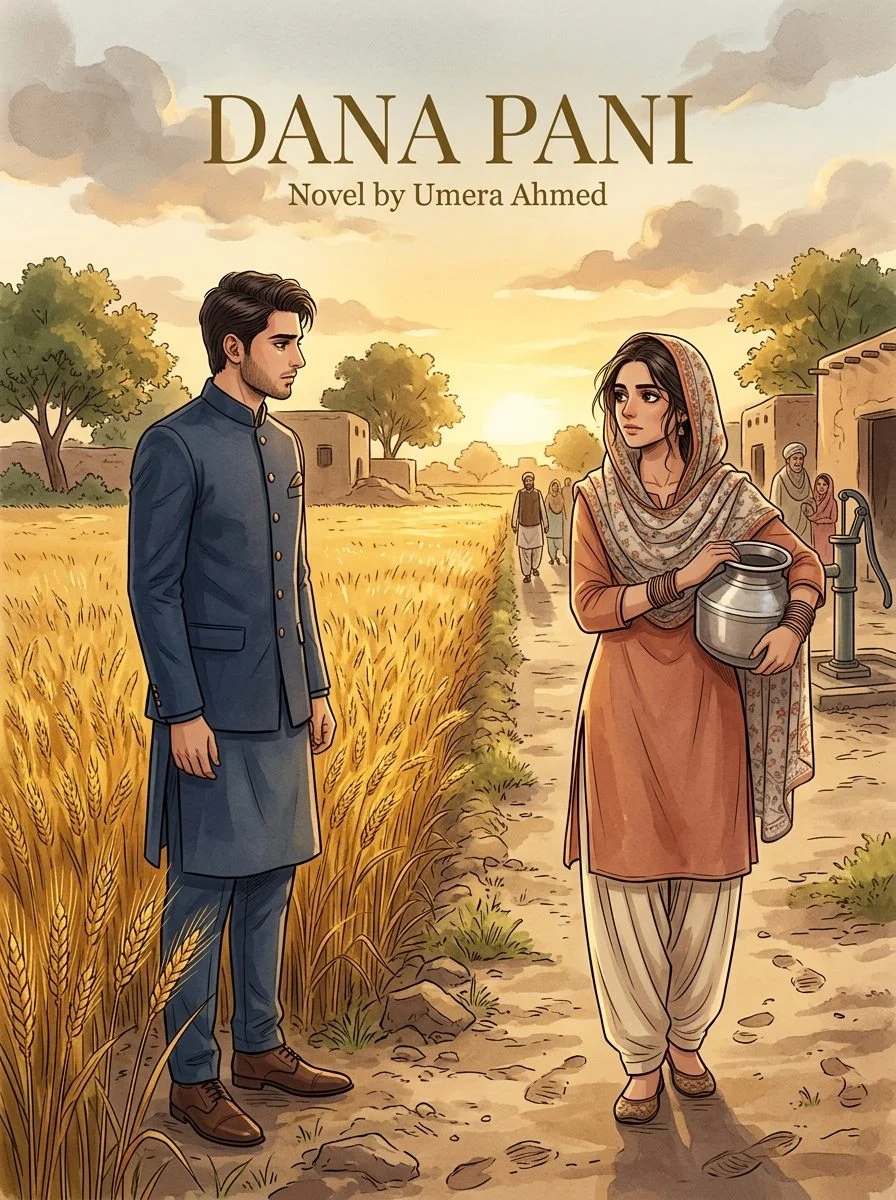
| Novel Name | Dana Pani (دانہ پانی) |
| Author | Umera Ahmed |
| Language | Urdu |
| Genre | Sad |
| PDF Page Count | Around 229 pages |
| PDF Available | Yes |
Dana Pani Urdu novel by Umera Ahmed. In one village some families own the grain and others carry the water, and the whole tragedy grows out of that single line. Around 229 pages, free here with the PDF.
In one village there are those who own the grain, and those who carry the water. Dana Pani builds an entire tragedy on that single divide. Written by Umera Ahmed and serialized in Khawateen Digest, it is an allegorical tale of arrogance and humility, love and jealousy, set in the dust of rural Punjab. Here’s the full story.
Shorter and plainer than La Hasil, and all the harder for it. One of the quieter sad Urdu novels on the site.
Quick Overview
Dana Pani is an allegorical social and romantic novel by Umera Ahmed, serialized in Khawateen Digest and beloved for its simplicity and depth. The title carries a double meaning that runs through the entire book. On one level it refers to destined sustenance, the share of provision, joy, and hardship written for each person. On another, it names the divide at the heart of the village: the “daane wale,” the Chaudharys with vast lands full of grain, and the “pani wale,” the poor who carry water and labour for their bread. Through these two symbols, Umera Ahmed tells a story of arrogance and humility.
Main Characters
- Motia: The heroine, the long-awaited only daughter of Gamu and Allah Wasai. Beautiful, intelligent, and highly educated, she carries deep dignity and becomes the emotional heart of the novel.
- Murad: Tajwar’s son and grandson of Pir Ibrahim, the charming son of the village Chaudhary. He returns home after completing his law degree abroad and falls in love with Motia at first sight.
- Gamu Mashki: Motia’s father, a humble water carrier known for selflessly providing water to the villagers.
- Allah Wasai: Motia’s mother, a devoted, patient, and grateful woman whose kindness defines her family.
- Tajwar (Tajoor): The Chaudhary’s daughter-in-law and Murad’s mother, a proud, vain woman who considers herself the epitome of beauty and status, and who nurses an unexplained jealousy toward Allah Wasai and Motia.
- Pir Ibrahim: Tajwar’s father and one of the novel’s most honourable figures, whose prayer brings Motia into the world and who lends the story its spiritual dimension.
- Batool: Motia’s so-called friend, whose secret feelings for Murad drive her conspiracies and misunderstandings between the couple.
Full Plot Summary
The story is set in a village called Jhok Jeewan, where Gamu Mashki and his wife Allah Wasai live a simple, contented life. Gamu is known for selflessly providing water to the villagers, while Allah Wasai is devoted and kind-hearted. For many years the couple remains childless, until a prayer from the honourable Pir Ibrahim is answered and Allah Wasai gives birth to a daughter, Motia. On the very same day, Tajwar, the new daughter-in-law of the village’s powerful landlord, arrives, and from that moment she begins to nurse an unexplained jealousy toward Allah Wasai and her child, a resentment that will shape everything that follows.
Motia grows into a beautiful, intelligent young woman who earns a medical degree, carrying her family’s dignity with her. Meanwhile Murad, Tajwar’s son and Pir Ibrahim’s grandson, returns to Pakistan after completing his law studies abroad. When he catches sight of Motia at the railway station, he falls in love at first sight, and she too is drawn to his charm and presence. Days later he meets her and proposes, but their families’ relationship has been strained since childhood, and the divide between grain and water stands between them like a wall.
Obstacles pile up quickly. Tajwar’s pride and jealousy make her a fierce opponent of the match, while Batool, Motia’s supposed friend, secretly loves Murad herself and works to create misunderstandings between the couple. Long-standing family rivalries, conspiracies, and the weight of social class turn a simple love into something torturous. Umera Ahmed uses these pressures to expose how ego, jealousy, and gossip can poison lives, showing the ugly reactions of a community when it learns that two people from different classes have fallen in love.
By the end, Dana Pani reveals itself as far more than a village romance. Its ending is genuinely tragic, and its lesson lands hard: that pride always falls, that all that glitters may not be gold, and that trust is the foundation without which love cannot survive. Woven through the sorrow is the novel’s central spiritual message about destiny, that each person receives the share written for them, and that real worth lies not in wealth but in strength of character and faith.
Central Themes
- Arrogance vs Humility: The grain and water symbolism drives the novel’s core allegory.
- Class Divide: The gulf between landlords and labourers shapes every relationship.
- Jealousy and Conspiracy: Tajwar’s pride and Batool’s schemes destroy what love builds.
- Destiny and Faith: The story insists that each person’s share in life is already written.
Why Readers Love Dana Pani
- A Powerful Allegory: The grain-and-water metaphor gives the story lasting depth.
- Vivid Village Setting: Umera Ahmed brings Jhok Jeewan and its people fully to life.
- Emotional Tragedy: The ending hits hard and stays with readers long afterward. A Short, Gripping Read: Compact enough to finish in one sitting yet deeply affecting.
Final Thoughts
Dana Pani is simple in size but heavy in meaning, a village tragedy that doubles as a meditation on pride, destiny, and human weakness. With its unforgettable class allegory, its wounded lovers, and its unflinching ending, it stands among Umera Ahmed’s most thought-provoking shorter works. If you enjoy Urdu fiction that blends romance with real social insight and spiritual reflection, Dana Pani is well worth reading.