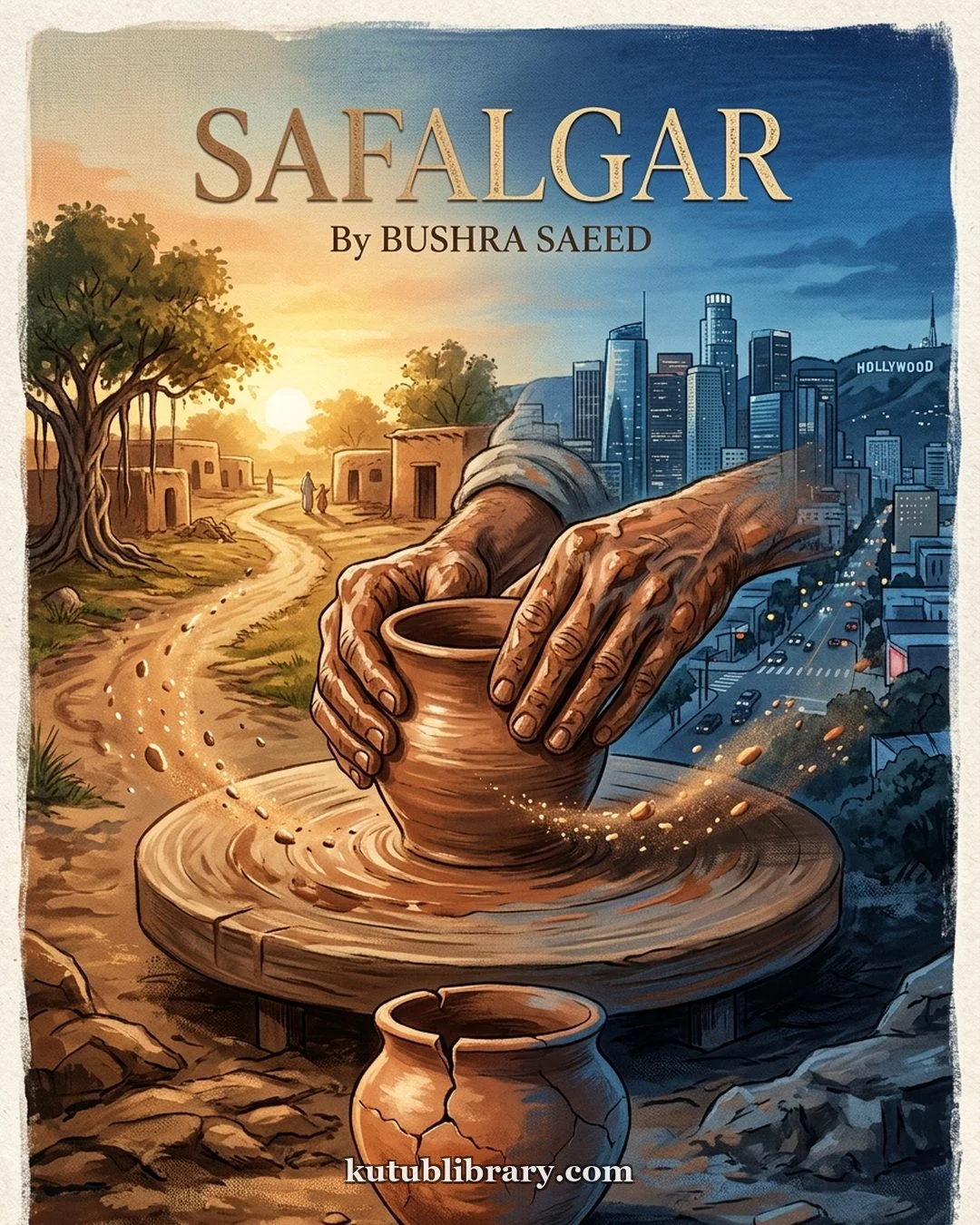
| Novel Name | Safalgar (سفال گر) |
| Author | Bushra Saeed |
| Language | Urdu |
| Genre | Islamic and Spiritual |
| Theme | Faith, Ambition, Identity, Grey Morality |
| PDF Page Count | 400 |
| PDF Available | Yes |
Safalgar Urdu novel by Bushra Saeed. A literary work about the hands that shape a person, told across two eras and three generations. Read the full novel here or download the 400-page PDF.
The title says it all before you even turn the first page. Sifaal means clay, and Gar means the one who shapes it. A potter. But in Bushra Saeed’s hands, this word becomes something far bigger. Safalgar is a novel about the forces that mold human beings, the way society, circumstance, faith, and personal choices press against us like a potter’s hands against wet earth, shaping us into forms we never planned to become. Spanning two different eras and multiple continents, this 400-page literary work is widely regarded as one of the finest achievements in contemporary Urdu fiction.
Quick Overview
Safalgar is a literary Urdu novel by Bushra Saeed that runs across two eras, three generations and two continents. One thread follows Ahmed Ibrahim, who renames himself Adam Grant and trades love for a Hollywood dream that never arrives. The other follows his abandoned son Umer, raised in a Pakistani village by an unskilled potter whose faith turns out to be the finest craft in the book.
Main Characters
- Ahmed Ibrahim (Adam Grant): The central figure of the novel and its most complex character. Ahmed is a Muslim man consumed by the dream of becoming a Hollywood star. He adopts the name Adam Grant to fit into the Western entertainment world, and his handsome appearance leads people to mistake him for a Christian. His obsession with fame forces him into an impossible choice between his career ambitions and Parniyaan, the woman he loves. He chooses career first, believing love can wait, and this single decision becomes the defining mistake of his life. He achieves neither stardom nor love, and his journey from ambition to regret forms the emotional backbone of the novel.
- Parniyaan: A devoted Christian girl whose love for Ahmed is absolute and unwavering. She is beautiful, deeply religious in her own faith, and incapable of imagining a life without Ahmed. Her story explores what happens when love crosses the boundaries of religion and culture, and how those boundaries can consume the very people caught between them. By the end of the novel, she has endured enough suffering to change any reader’s perspective on the cost of silence and separation.
- Umer: Ahmed’s son and the moral compass of the second era. Abandoned by his parents, Umer is raised in a rural village by Hakeem Begum. He grows into a pious, principled young man, the complete opposite of his father. His faith is not inherited through fear but built through genuine love and lived experience. His connection with Sofia and his unwavering trust in prayer make him one of the most quietly powerful characters in the story.
- Sofia: A deeply scarred young woman who grows up hating her parents and, by extension, hating God. Her childhood under Grant’s cruelty leaves her convinced that she is worthless, and she rebels against everything her upbringing tried to force on her. Sofia’s arc is one of the most painful in the novel, but also one of the most rewarding, as Umer’s presence in her life slowly opens the door to healing and genuine faith.
- Hakeem Begum: The undisputed heart and soul of the novel. A simple, unskilled rural potter (kumhaarn) who can never quite shape a proper clay vessel, yet she molds Umer into one of the finest human beings in the story. Her faith in God is unshakable, her hospitality is boundless, and her Punjabi dialogue carries a warmth and wisdom that readers consistently name as their favorite part of the book. She gives shelter to a woman whose presence threatens her own reputation, yet she never wavers. Hakeem Begum proves that the truest potter is not the one with the most skill but the one with the most sincerity.
- Alba Marsello: A morally ambiguous woman whose life becomes entangled with Ahmed’s world. Once she falls in love, she loses sight of everything else, including her own children. Her character represents how unchecked passion, when combined with a lack of moral grounding, can consume a person entirely.
- Dawood: Parniyaan’s cousin, a doctor by profession, who carries quiet feelings for her. His presence adds another layer of emotional tension to the central love story.
Full Plot Summary
Safalgar opens on an American road, immediately signaling that this is not a typical Urdu novel confined to drawing rooms and family gatherings. The narrative stretches across continents, from the dusty lanes of a Pakistani village to the polished surfaces of the American entertainment industry, and across three generations, beginning with Ibrahim, moving through his son Ahmed, and arriving finally at Ahmed’s son, Umer.
The story’s first thread follows Ahmed Ibrahim, a young Muslim man whose obsession with Hollywood drives every decision he makes. He renames himself Adam Grant, models his identity after the Western world he desperately wants to enter, and chases a dream that promises everything but delivers nothing. Along the way, he falls in love with Parniyaan, a Christian girl whose devotion to him is immediate and total. For a time, they exist in the space between two worlds, where religion and culture have not yet caught up with emotion.
But Ahmed makes a choice. He decides that fame must come first, that Parniyaan will wait, and that he can have both if he is patient enough. It is a miscalculation that ruins him. He never becomes the star he imagined, and Parniyaan does not remain within reach. The novel captures this tragedy not as a sudden collapse but as a slow unraveling, where each wrong turn makes the next one seem inevitable.
Parallel to Ahmed’s downfall runs the story of Umer, his son, who grows up in an entirely different world. Abandoned by his parents, Umer is raised in a rural village by Hakeem Begum, an illiterate potter whose hands cannot shape clay into anything beautiful but whose heart shapes the boy into something extraordinary. She teaches him faith not through punishment or fear but through her own example, through prayers that carry no doubt, through patience that never asks for a reason.
Umer’s path eventually crosses with Sofia, a young woman whose childhood was destroyed by Grant’s cruelty. Sofia was raised to believe she was inherently flawed, a daughter of sin with no right to divine mercy. She turned away from God not out of logic but out of pain, because every person who represented religion in her life used it as a weapon. Umer’s quiet, genuine faith becomes the first encounter Sofia has with a version of God that does not punish.
Bushra Saeed weaves these two eras together with remarkable skill. The past and present do not simply alternate. They speak to each other. Ahmed’s choices echo in Umer’s circumstances. Parniyaan’s suffering finds its mirror in Sofia’s pain. And Hakeem Begum, the unskilled potter who never made a perfect vessel, stands as the novel’s quiet thesis: that the value of creation lies not in technique but in intention, not in perfection but in sincerity.
The novel’s final hundred pages shift the tone dramatically. After nearly three hundred pages of unrelenting emotional weight, the story turns toward light. Not a convenient, easy resolution, but a deeply earned one, built on the foundation of every prayer, every act of patience, and every moment of faith that came before it. The message is clear but never preachy: when a person seeks guidance from the right source, even the most misshapen vessel can find its form.
Central Themes
- The Potter Metaphor: Society, family, and circumstance act as potters who shape human identity. Some mold with care, others with carelessness, and the novel examines how each approach produces fundamentally different outcomes.
- Faith vs Forced Religion: One of the novel’s strongest messages is the difference between teaching faith through love and imposing it through fear. Children raised with punishment in the name of God often turn away from Him entirely.
- Ambition and Its Cost: Ahmed’s pursuit of Hollywood fame at the expense of love and family illustrates how unchecked ambition can hollow a person out from the inside.
- Cross-Cultural Love: The relationship between a Muslim man and a Christian woman is handled without simplistic conversion narratives, focusing instead on the genuine emotional and spiritual complexity of such connections.
- Trust in God: Hakeem Begum’s unshakable tawakkul, free of doubt and complaint, serves as the novel’s spiritual anchor, proving that true strength comes from surrender, not control.
- Grey Morality: Unlike most Urdu novels, Safalgar presents characters who are neither fully good nor fully bad. Every person has reasons for their mess, and every wrong action has a human explanation behind it.
Why Readers Love Safalgar
- The title and its metaphor create a conceptual framework that lifts the novel beyond a simple story into a philosophical exploration of human nature.
- Hakeem Begum is universally praised as one of the most memorable characters in contemporary Urdu fiction, with her Punjabi dialogue and unbreakable faith winning readers across every review.
- The dual-era structure keeps the narrative fresh, connecting past and present in ways that feel organic rather than forced.
- Bushra Saeed’s prose is rich and literary, with a command of language that challenges readers while rewarding them with deeper understanding.
- Characters operate in moral grey areas, making them feel genuinely human rather than fictional archetypes.
- The novel does not take shortcuts with its religious themes. It earns its spiritual message through character development and emotional truth, not through preaching.
- At 400 pages, the story provides a full, immersive reading experience that readers describe as difficult to start but impossible to put down once the threads connect.
Final Thoughts
Safalgar is not a novel you read for comfort. It is a novel you read because it refuses to leave your mind after you finish it. Bushra Saeed has created a work that spans continents and generations, that holds up a mirror to the forces shaping every human life, and that ultimately argues for the kind of faith that does not shout but endures. The potter’s wheel turns, the clay resists, and somewhere in the tension between the two, a shape emerges. Whether that shape becomes something beautiful depends entirely on the hands doing the work. For readers who appreciate literary Urdu fiction with philosophical depth, complex characters, and emotional honesty, Safalgar is essential reading.
For readers who want Urdu fiction with this kind of weight, Dana Pani and Usri Yusra are the closest company Safalgar has on this site.